I. GENERAL INTRODUCTION TO THE VIETNAM ACADEMY OF FOREST SCIENCES
General information
The Vietnam Academy of Forest Sciences is a public science and technology organization under the Ministry of Agriculture and Environment, classified as a special-grade institution pursuant to Decision No. 2099/QĐ-TTg dated November 25, 2011 of the Prime Minister.
On December 31, 2025, the Forest Inventory and Planning Institute was merged and became a subordinate unit of the Vietnam Academy of Forest Sciences under Decision No. 5928/QĐ-BNNMT issued by the Ministry of Agriculture and Environment.
The Vietnam Academy of Forest Sciences has full legal status, its own seal, and is authorized to open accounts at the State Treasury and commercial banks to operate in accordance with the law.
– Organization name: VIỆN KHOA HỌC LÂM NGHIỆP VIỆT NAM
– International transaction name: VIETNAM ACADEMY OF FOREST SCIENCES (VAFS)
– Address: No. 46, Duc Thang street, Đong Ngac ward, Hanoi city, Vietnam
– Website: www.vafs.gov.vn – E-mail: [email protected]
– Tel: (+84).243.838.9031 – Fax: (+84).243.838.9722
II. ORGANIZATIONAL STRUCTURE
The Vietnam Academy of Forest Sciences possesses a large-scale workforce, with a total of 902 staff members, experts and technicians working nationwide. With a well-structured and widely distributed human resource network, the Academy is capable of synchronously implementing large-scale tasks in the forestry sector.
In addition to its workforce size, the Academy has a notable advantage in academic depth and specialized research capacity. Its scientific staff includes 03 Professors, 05 Associate Professors, 121 PhD holders and nearly 300 Master’s degree holders, who play a core role in research, methodological development and the formulation of technical standards in areas such as forest inventory, biomass and carbon, remote sensing and GIS, sustainable forest management and climate change. At the same time, a team of experienced technical staff and field experts is responsible for field measurement, verification and operation of forest resource monitoring systems, ensuring the accuracy and reliability of large-scale data.
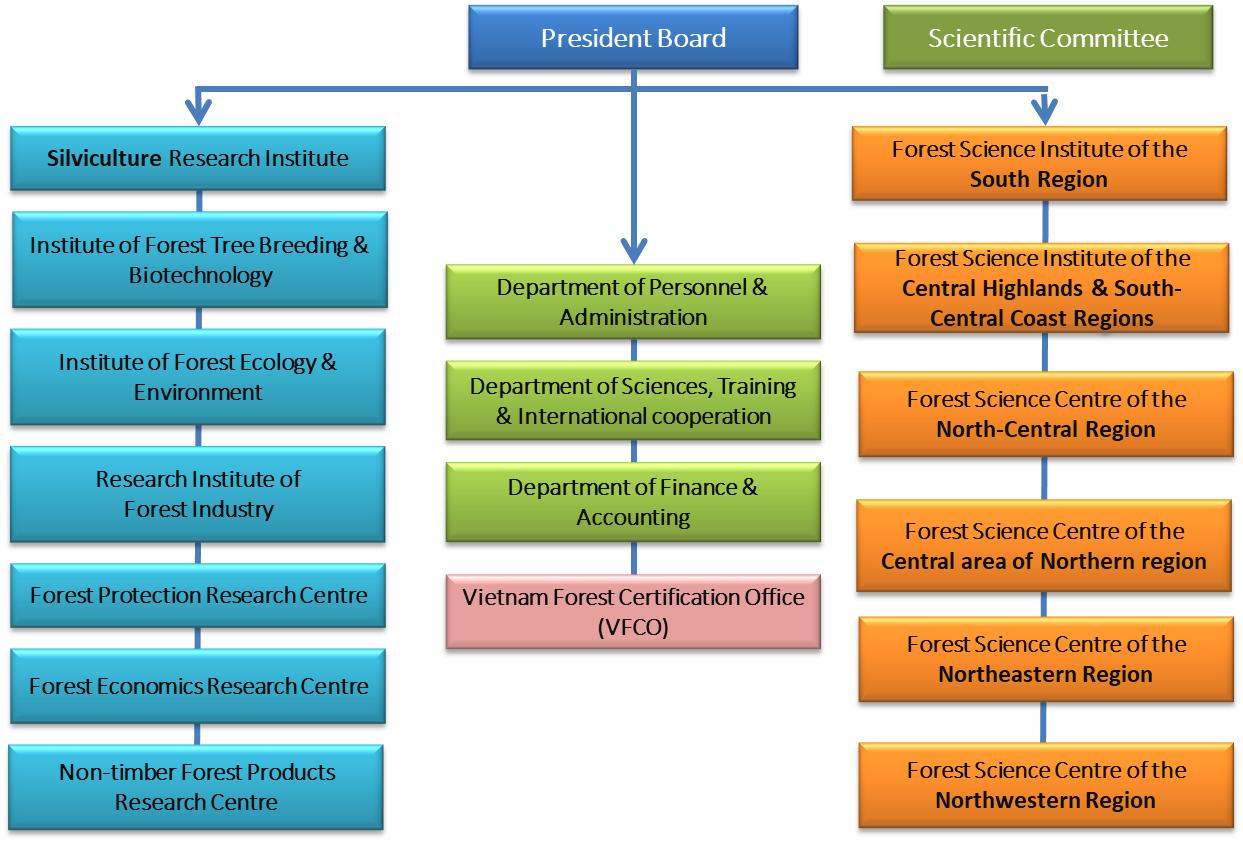
– Advisory departments:
+ Department of Personnel and Administration;
+ Department of Science, Training and International Cooperation;
+ Department of Finance and Accounting.
– Affiliated units:
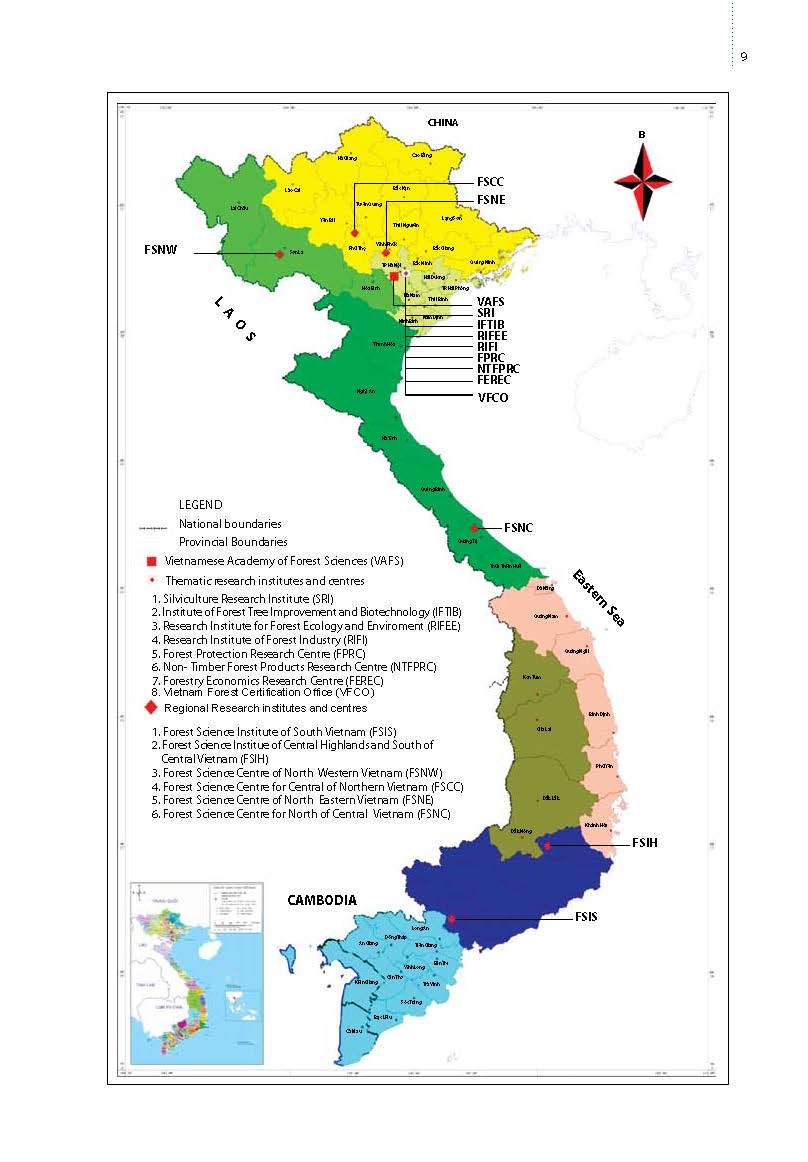
+ Silviculture Research Institute, headquartered in Hanoi city;
+ Research Instititue of Forest Industry, headquartered in Hanoi city;
+ Institute of Forest Tree Breeding and Biotechnology, headquartered in Hanoi city;
+ Institute of Forest Ecology and Environment, headquartered in Hanoi city;
+ Forest Science Institute of the South Vietnam, headquartered in Ho Chi Minh city;
+ Forest Science Centre of Northwestern Vietnam, headquartered in Son La province;
+ Forest Science Centre for Central of Northern Vietnam, headquartered in Phu Tho province;
+ Forest Science Centre of Northeastern Vietnam, headquartered in Phu Tho province;
+ Forest Science Centre for North of Central Vietnam, headquartered in Quang Tri province;
+ Forest Science Institute of the Central Highland and South of Central Vietnam, headquartered in Lam Dong province;
+ Non-timber Forest Products Research Centre, headquartered in Hanoi city;
+ Forest Protection Research Centre, headquartered in Hanoi city;
+ Forest Economics Research Centre, headquartered in Hanoi city.
+ Vietnam Forest Certification, headquartered in Hanoi city.
+ Forest Inventory and Planning Institute, headquartered in Hanoi city;
III. FACILITIES AND FINANCIAL CAPACITY
Facilities
– Land, workshops and nursery systems serving research:
The Vietnam Academy of Forest Sciences has 07 research institutes, 01 Sustainable Forest Management Certification Office and 07 regional centers under its system, with a total experimental land area of over 11,000 hectares across the Northern Central region, Northeast, Northwest, North Central, South Central, Central Highlands and Southern regions. These areas can be utilized for establishing experimental models for research projects. In addition, the nursery systems and cutting propagation facilities of the above-mentioned units are well-positioned to meet the needs for breeding research and seedling production for experimentation as well as production and business purposes. The Academy also operates workshops for research and testing of wood physical and mechanical properties, among others,…
– Main equipment:
Over the years, the Vietnam Academy of Forest Sciences has received relatively comprehensive and systematic investments in research equipment from scientific funding sources, development investment and international projects. To date, the Academy’s laboratory system is relatively modern and well-equipped across multiple disciplines. Several laboratories have been accredited under VILAS standards, while others are under consideration for recognition as national key laboratories. These facilities fully meet the requirements for implementing research activities. Key laboratories of the Academy include:
– Laboratory for breeding, selection and propagation;
– Laboratory for physiology, ecology and soil analysis;
– Laboratory for forest protection;
– Laboratory for forest product preservation;
– Laboratory for wood physical and mechanical properties;
– Laboratory for forest product processing and forest chemistry;
– Laboratory for forest engineering and GIS..
– Laboratory for forest engineering and GIS.
In addition, the Academy’s equipment system is organized in an integrated manner, covering the entire process from field data collection to processing, analysis and database development. Specifically:
– Field survey equipment is fully equipped, including specialized measurement tools such as diameter and basal area measuring devices, height meters, distance and inclination measuring instruments using laser and ultrasonic technologies, handheld GPS devices, and electronic data collection devices (PDA), thereby improving the accuracy and efficiency of field measurements.
– Advanced measurement technologies such as terrestrial 3D laser scanning (LiDAR) and modern measurement devices (FieldMap, TruPulse, Vertex, etc.) are widely applied in forest surveys, inventories and detailed forest structure assessment.
– Digital mapping systems and GIS technologies are systematically developed, enabling the management, integration and updating of forest resource data on digital platforms. This forms a critical foundation for establishing a closed technological workflow, from data collection and processing to analysis, mapping and database development for management purposes.
– Modern remote sensing technologies are applied, utilizing high-resolution satellite imagery (QuickBird, Ikonos, SPOT, etc.) combined with advanced digital image interpretation methods (object-based approaches), thereby enhancing the accuracy of forest status mapping, monitoring forest resource changes and supporting greenhouse gas emission reduction programs.
– Specialized software and data processing systems are used for data calculation, analysis and standardization, contributing to ensuring consistency, transparency and reliability of information for management and decision-making.
In addition, the institutes and regional centers under the Vietnam Academy of Forest Sciences are also equipped with devices for rapid field measurement and research of plant physiological indicators, environmental factors, propagation, and related activities, …
Financial capacity
The Vietnam Academy of Forest Sciences is a public science and technology organization with functions in scientific research and technology transfer. Therefore, its operational funding sources are diverse, including state budget allocations, international cooperation, and consultancy and technology transfer service contracts. The Academy consistently fulfills all financial obligations to the State. In recent years, revenue from consultancy services has shown an increasing trend annually and has generated stable profits.
IV. EXPERIENCE IN SCIENCE AND TECHNOLOGY ACTIVITIES
4.1. Key Achievements of the Academy during 2020-2025
4.1.1. Science and technology activities
* Breeding and development of new varieties
During the period 2020–2025, the Academy achieved several breakthroughs in applying advances in biotechnology and tree improvement research, such as polyploid technology, genetic transformation, and molecular marker technologies, to develop new varieties and shorten the forest tree improvement cycle. Over the past five years, the Academy has had 82 new varieties officially recognized by the Ministry for major tree species, including: Hybrid eucalyptus (33), Hybrid acacia (20), Acacia mangium (2), Triploid acacia (4), Acacia auriculiformis (11), Macadamia (7), Ailanthus triphysa (5), Sonneratia apetala (2), and Sterculia foetida (7).
In addition, the Academy has been granted protection titles for 11 new varieties, including hybrid acacia and triploid acacia. It has also been granted a utility solution patent for the propagation process of Acacia crassicarpa, and its applications for protection of 10 new hybrid acacia varieties have been accepted. The newly developed acacia and eucalyptus varieties have an average productivity of 25 m³/ha/year or higher, making a significant contribution to improving the productivity and quality of plantation forests and providing raw materials for the wood processing and forest product industries. These new varieties have been and are being widely introduced into production, with 45 varieties already in common use.
The Academy has continued to establish over 100 hectares of seed orchards for acacia and eucalyptus species across various ecological regions nationwide (under the national seed program), of which 48 hectares have been officially recognized by the Ministry of Agriculture and Rural Development (now the Ministry of Agriculture and Environment). The Academy is also maintaining more than 1,000 hectares of converted seed stands, seed forests, seed orchards, base seed collections, and provenance and progeny trials serving research and the production of planting materials for eucalyptus, pine, acacia, indigenous species, as well as species adapted to sandy areas and coastal mangrove ecosystems..
The seed orchards, after establishment and genetic thinning, have been transferred to local production facilities for continued management and seed collection for afforestation. Annually, the Academy is capable of supplying over 300 kg of seeds for major plantation species; 7 million commercial seedlings and base planting materials; more than 1 million indigenous seedlings; and over 5,000 units of base planting materials to replace degraded stock in nurseries.
* Recognition of new Technical Advances (TAs)
The Academy has promoted the recognition of technical Advances and has been granted official recognition by the Ministry of Agriculture and Rural Development for 44 new TAs in the following fields: breeding (19), silviculture (3), forest protection (10), and forest industry (12).
During the period 2020–2025, the Academy developed a database software on soil characteristics and site suitability for afforestation of major tree species in Viet Nam, integrated with the FORMIS system (National Forest Resource Management Information System), which consolidates comprehensive data on forest area, volume and forest owners from plot level to national level. The Academy was also granted a Copyright Registration Certificate by the Copyright Office of Viet Nam – Ministry of Culture, Sports and Tourism for the Vietnam Legal Timber Traceability Software (iTwood). In addition, the Academy has been granted utility solution patents for 6 innovations by the Intellectual Property Office of Viet Nam, and 13 new plant varieties have been protected by the Department of Crop Production and Plant Protection.
4.1.2. Development of Technical Standards
During the period 2020–2025, the Academy was assigned by the Ministry of Agriculture and Environment to develop 68 Technical Standards (TCVN). To date, 47 TCVN have been officially promulgated by the Ministry of Science and Technology (MOST); 9 tasks have been appraised and assigned standard codes; and 12 TCVN are under implementation, of which 6 have been accepted at the ministerial level and submitted to MOST for appraisal. The TCVN developed by the Academy have made important contributions to the management of specialized sectors and serve as a basis for organizations and individuals to apply in practice, supporting the development of the forestry sector.
4.1.3. Scientific publications
The Academy has published 26 books on scientific and technological research results, 662 scientific articles in domestic specialized journals, and 230 international publications. The Academy also publishes 6 journal issues annually, each containing a relatively rich number of articles ranging from 13 to 21 (an average of 17 articles per issue), along with 5 special issues for its affiliated units. In 2024, the Academy developed an online journal management system for the Journal of Forestry Science, which has been in operation since Issue No. 4 of 2024 at https://vjfs.vafs.gov.vn, and implemented the assignment of Digital Object Identifiers (DOI) for published articles.
4.1.4. Transfer of Technical Advances (TAs) and science and technology services
Annually, the Academy transfers new technical advances in breeding, silviculture techniques, harvesting, processing and preservation of forest products to more than 27 organizations both domestically and internationally; and implements dozens of consultancy service contracts on forest planning, afforestation design, development of sustainable forest management plans and preparation of forest certification dossiers for forest owners across different ecological regions.
Under the task “Support for production, supply and conservation of base planting materials for forest tree species under Decree 32/CP” during 2020–2021, the Academy supplied 1,629,350 base seedlings and 13,245 units of base planting materials to production units nationwide, and conserved 50 base varieties for species such as hybrid acacia, hybrid eucalyptus, Acacia auriculiformis, macadamia and Amomum longiligulare. In addition, the Academy has proactively produced 6–8 million high-quality commercial seedlings annually to directly supply production needs.
In addition to technology transfer contracts, each year the Academy undertakes dozens of contracts and assignments related to timber verification, judicial expertise, and assessments serving the CITES Viet Nam Authority, thereby actively supporting state management in the forestry sector.
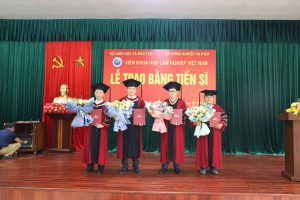
The Academy has been assigned to provide doctoral training since 1982 (being the first institution in the forestry sector to offer PhD training). To date, it has conducted 37 cohorts, enrolling 226 doctoral candidates (PhD candidates), of whom 191 have successfully defended their dissertations. Currently, the Academy provides doctoral training in 5 specializations, including: Silviculture, Forest Inventory and Planning, Forest Tree Genetics and Breeding, Forest Resource Management, and Forest Product Processing Technology.
During the period 2020–2025, the Academy newly enrolled 27 PhD candidates, and 35 candidates successfully defended their dissertations. At present, the Academy is training 30 PhD candidates.
4.1.6. International cooperation
The Academy has established and implemented cooperative activities with relevant organizations such as ACIAR, FAO, CIFOR, ICRAF, JICA, GIZ, AKEKOP, Tropenbos International, IUCN, etc. In addition, the Academy is a member of organizations such as IUFRO, APAFRI, SANFRI, etc. The Academy is also an important partner in implementing forestry development projects funded by international organizations such as ADB, WB, KfW, JICA, etc., through the provision of consultancy services and experts for project design and implementation, human resource training, development of technical guidelines, etc.
To date, the Academy has signed a total of 24 MoUs with international partners. Among significant international cooperation events, the Academy has hosted the U.S. Secretary of Agriculture for the inauguration of the DART technology laboratory; organized SANFRI Steering Committee meetings and forums with participation from representatives of 8 countries; signed a Memorandum of Understanding on the exchange of new wood material samples with the Embassy of Finland; and organized the PEFC International Week in Ho Chi Minh City in 2025.
4.2. Some tasks in related fields implemented by the Academy
The Vietnam Academy of Forest Sciences and its staff have carried out numerous scientific research and technology transfer tasks in the fields of forest resource inventory, carbon stock assessment, silviculture, sustainable forest management and forest certification, development of sustainable forest management plans, and forest resource surveys. Some representative tasks are listed in the Appendix 1.